


Introduction
At some point, every founders will have to ask: Where should I put my energy, long-form content or social media?
It’s tempting to chase the fast-moving current of likes, shares, and algorithm spikes. But while social media creates reach, long-form content creates roots. Authority doesn’t come from the loudest voice. It comes from the voice people remember, return to, and trust.
This article breaks down what each channel does best, how they work together, and a 30-day plan to build authority without burning out.
TL;DR — From Brand to Culture
- Most brands sell products; few create culture.
- Culture begins when your why, what, and how align into one system.
- Resonance turns loyalty into community, and community into legacy.
- Every story, system, and signal becomes a cultural act.
- Brands that design for reciprocity don’t fade, they endure.
What Long-Form Content Does Best (Library = Roots)

Long-form content is the library of your brand.
- Depth & proof: Blogs, podcasts, YouTube, and Substack provide space to explain ideas fully.
- Search authority: Well-structured long-form compounds over time, attracting people through SEO. Long content receives an average of 77.2% more backlinks than short articles (DigitalThirdCoast, 2025).
- Retention & trust: People return to long-form resources, cite them, and share them. 72% of marketers say long-form content generates more qualified leads than short-form (Amra & Elma, 2025).
- Repurposing engine: A single anchor can fuel weeks of micro-content.
Authority is not built in bursts. It’s built in archives. Long-form content makes your expertise discoverable and enduring.
What Social Media Does Best (Showcase = Branches)

Social media is the showcase of your brand.
- Speed: Instant reach and cultural relevance. Short-form videos are the top ROI driver for 71% of video marketers; only 22% say long-form video achieves the highest ROI (Sprout Social, 2025).
- Engagement: Short-form makes your brand feel alive and accessible.
- Connection: Direct interaction with your community in real time.
- Amplification: Pushes your long-form into circulation.
But social is rented space. Algorithms decide visibility. Posts vanish within hours. Alone, social can’t sustain authority, it can only amplify it.
How They Work Together (Roots → Branches → Back Home)
Authority is built when long-form creates roots and social creates branches.
Anchor → Atomize → Redirect
- Anchor: Publish one long-form piece (blog, video, podcast). Every anchor optimized for SEO and internal links. Usage of long-form articles increased from 22% in 2022 to 42% in 2023 (DemandSage, 2025).
- Atomize: Break it into 4–6 micro-stories (clips, quotes, graphics).
- Redirect: Send every post back to your website, blog, or list.
The Brand Home Rule
Owned assets (website, email, long-form library) are where authority compounds. Social media should always point people home. Both forms of content should point back to your brand home ↗. Trying to do everything at once leads to scattered energy. Authority requires sequence.
Sequencing Your Content Strategy (Avoid Burnout)
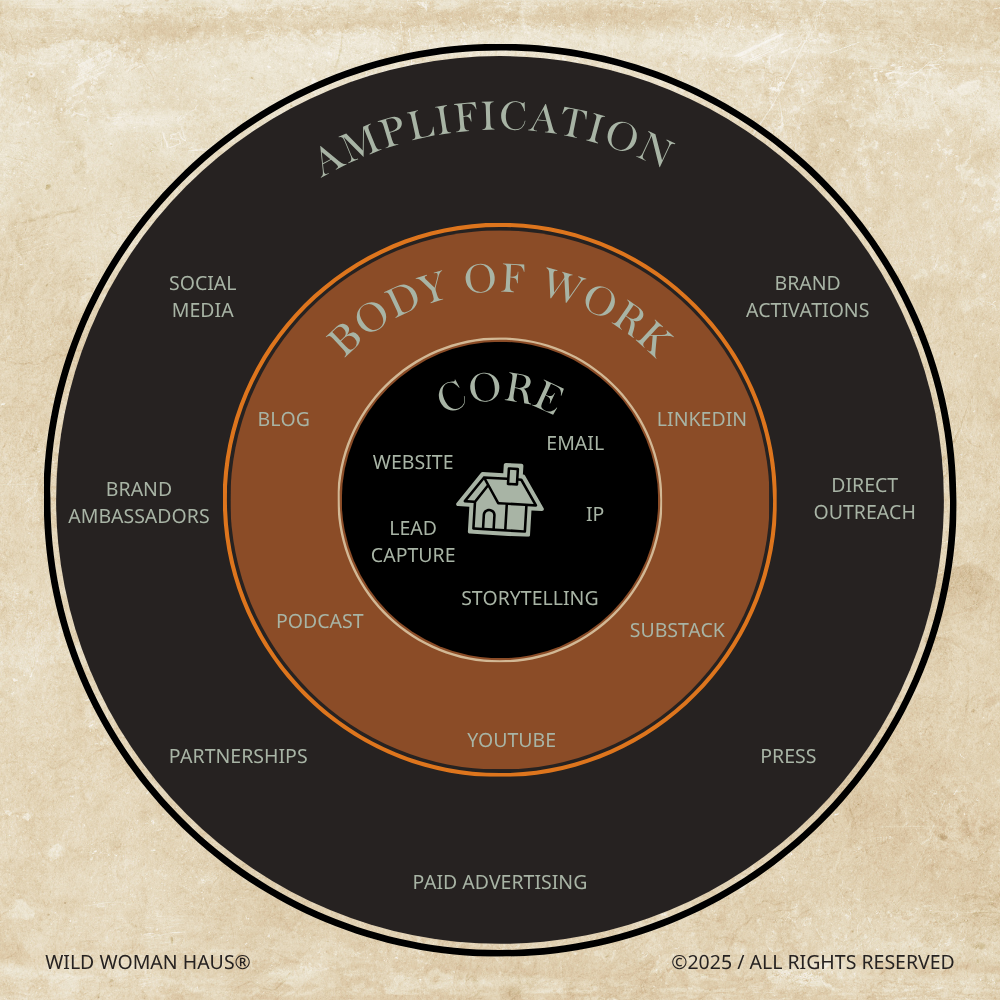
Phase 1 — Build the Core
Choose one long-form lane (blog, YouTube, or podcast). Publish consistently every 2–4 weeks.
Phase 2 — Repurpose for Social
Turn each anchor into 4–6 micro-stories across your chosen platforms.
Phase 3 — Capture & Nurture
Use lead magnets and a welcome series to move visitors from social to your email list.
Phase 4 — Expand With Intention
Add partnerships, PR, or activations after your home is strong.
Long-Form vs Social
Brand A (Social-Only, Disappears When Algorithms Shift): Wellness or beauty brands whose primary content is short video or lip-synch style, great when trends favor them, but no content legacy or SEO value.
Brand B (Long-Form Library → Repurpose into Social): Think of HubSpot’s approach (though B2B) or in beauty, brands with extensive blog / tutorial / educational content (e.g. Paula’s Choice, which has long-form content about skin science). They repurpose these into video, email, social, so they build compounding value.
Practical Framework — Authority Checklist
- One primary long-form lane selected
- Each anchor optimized for SEO and internal links
- 4–6 social assets extracted per anchor
- Every social post links back to owned assets
- Email list capture + nurturing in place
- Authority metrics tracked
Metrics That Prove Authority (Beyond Likes)
- Returning visitors & branded search
- Time on page & saves/shares
- Email opt-ins & replies
- Referrals & content-assisted sales
30-Day Decision-Stage Plan
Week 1 — Choose & Draft
Pick your long-form lane. Draft your first anchor piece with a clear CTA.
Week 2 — Publish & Package
Publish the anchor. Slice it into 4–6 micro-assets.
Week 3 — Redirect & Capture
Make sure every social post links back to your website or lead magnet. Launch a 3-email welcome series.
Week 4 — Measure & Improve
Track authority metrics. Refine cadence, topics, and repurposing process.
FAQs
Is long-form content better than social media for authority?
Yes. Long-form builds durable authority; social amplifies it. Start with long-form, then extend into social.
How often should I publish long-form?
Every 2–4 weeks consistently. Quality and rhythm beat volume.
Do I need to be everywhere on social?
No. Choose 1–2 platforms your audience actually uses and sustain presence there.
What should I measure to confirm authority?
Look at returning visitors, branded search, email opt-ins, shares, referrals, and content-assisted sales.
How do I repurpose efficiently?
Anchor content → 4–6 micro-stories → email → partner pitch. Use a repeatable system.
Conclusion
Social media creates reach. Long-form creates roots. Authority needs both, but in sequence.
Start with depth. Build a library that compounds. Then use social to amplify, connect, and redirect people home.
Because authority doesn’t come from trends. It comes from trust built over time. They fit into the larger Marketing Engine sequence ↗.
→ Ready to design a content system that builds authority without burnout? Explore our Services Guide or book a Discovery Call to align your long-form and social strategy for lasting impact.

