


Introduction
Most brands know what they sell. Few know why they exist.
A tagline or mission statement is not the same as brand purpose. Purpose is your North Star, the anchor that directs every decision, keeps teams aligned, and turns scattered tactics into culture. Without it, you drift. With it, you build with clarity and coherence.
Here’s how to define your brand purpose and use it as the compass that guides growth.
TL;DR — Your Brand’s North Star
- Most brands know what they sell; few know why they exist.
- Purpose anchors direction, coherence, and trust.
- It aligns offers, positioning, and storytelling into one compass.
- Without purpose, energy scatters; with it, every action compounds.
- Your why is the North Star that turns motion into meaning.
What Is Brand Purpose?

Beyond Profit Into Alignment
Brand purpose is the reason your business exists beyond profit. Yes, money sustains you, but purpose directs profit toward impact. It ensures that decisions add up to more than campaigns; they create culture.
The Two Layers of Value
- Literal Value: your tangible deliverables, skills, and expertise.
- Abstract Value: your perspective, shaped by lived experiences, what no competitor can replicate.
Purpose sits at the intersection. When both values are clarified, your brand becomes memorable and magnetic, brands with purpose score 27% higher in customer loyalty (Deloitte 2023 / via Amra & Elma).
Why Defining Brand Purpose Matters
The Cost of an Unclear Purpose
Without a clear why, brands chase every shiny tactic. The result?
- Fragmented identity
- Wasted resources
- Short-lived attention
- A brand people forget as quickly as they discover it
The Benefits of Anchored Purpose
A strong purpose:
- Filters distractions and focuses energy
- Aligns offers, positioning, and storytelling
- Preserves resources by preventing scatter
- Creates cultural coherence inside and outside the brand.
In fact, 70% of people across 25 countries report they buy from brands that reflect their own principles (Ipsos / WeForum). When purpose acts as your North Star, every action compounds into identity and trust.
How to Define Your Brand Purpose

Step 1 — Clarify Your Why
Write a two-line purpose statement:
- One line for your literal value (skills, outcomes).
- One line for your abstract value (unique perspective).
Quick check: if your team can’t repeat it and your customers can’t feel it, it isn’t clear enough.
Step 2 — Align With Responsibility
Ask: Is this the best use of our resources, financial, human, creative?
Purpose includes stewardship. Brands that shift from consuming to recirculating value create sustainable growth and community trust, purpose-driven companies tend to have 40% higher workforce retention than others (Cigna / Deloitte).
Step 3 — Connect to Community
Purpose is never just about the founder. It must serve a wider ecosystem. Strong purposes build reciprocity: value exchanged back and forth through service, content, or care.
Brand Purpose in Action
Purpose-Driven vs. Trend-Driven
- Purpose-Driven Brand: Filters decisions through the North Star. Delivers consistently. Earns trust. Builds culture, consumers are four to six times more likely to buy from, trust, champion, and defend companies with a strong purpose (Forbes / Afdhel Aziz).
- Trend-Driven Brand: Chases hype. Burns resources. Confuses audiences. Fades quickly.
From Philosophy to Practice
Purpose isn’t theoretical. It informs:
- Offers: What you put into the market (and what you don’t).
- Positioning: How you define your difference.
- Storytelling: The narratives that let people feel your values in action.
Storytelling at the Heart of Purpose

From Information to Memory
Purpose becomes powerful when it’s translated into stories. Stories turn information into meaning, helping strangers understand why you exist and why it matters.
Archetypes as Emotional Connectors
Archetypes embody universal desires, freedom, safety, mastery, belonging. Anchoring to one helps you connect with people not only as they are, but as who they want to become. Purpose plus archetype equals resonance.
Every Decision Sends a Signal
Purpose isn’t abstract. It shows up in choices like:
- Messaging: Language shapes expectations.
- Pricing: Communicates value and confidence.
- Service: Boundaries and responsiveness build trust.
- Design: Website, onboarding, and spaces shape felt experience.
- Partnerships: Who you align with signals what you stand for.
- Retention: Reciprocity turns buyers into members.
Every action becomes a cultural signal. Purpose ensures those signals align.
The Concentric System (Home → Surrounding → Amplification)
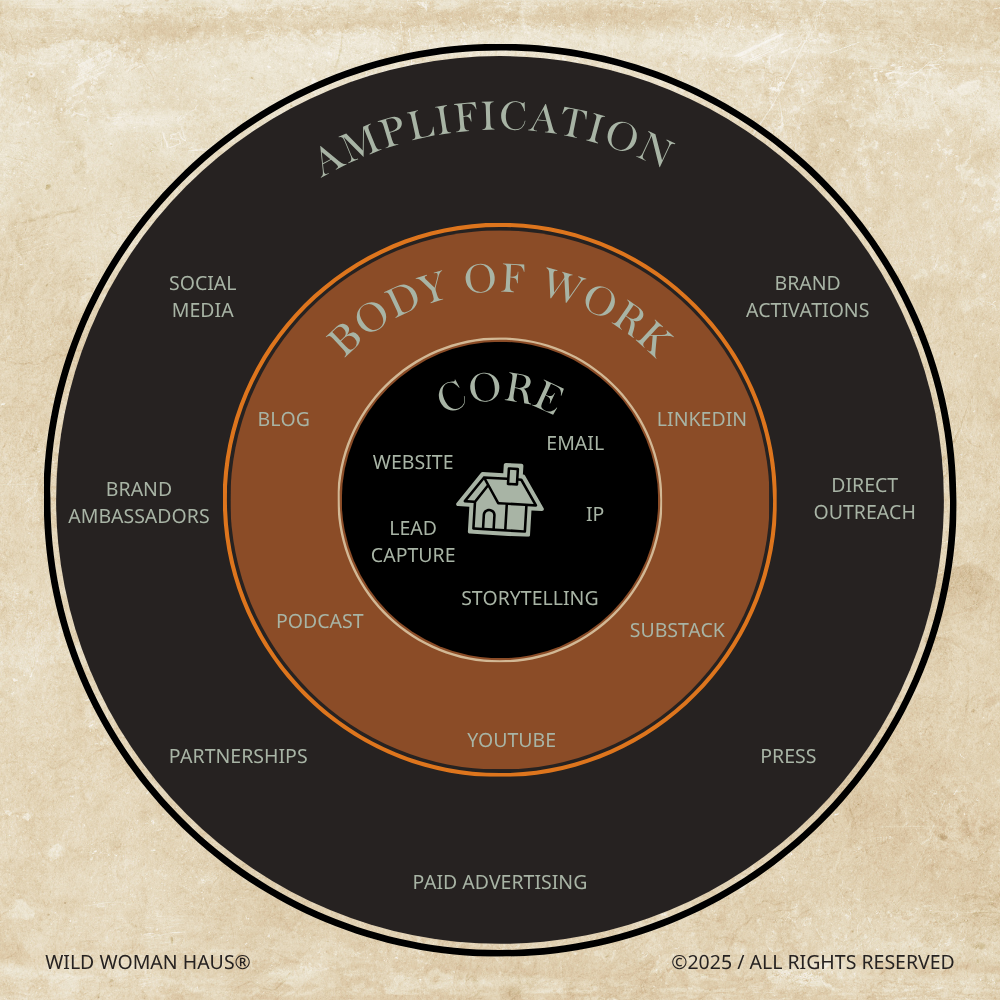
- Home: Website, storytelling, lead capture, and email. Your cultural anchor.
- Surrounding: Blogs, podcasts, YouTube, Substack. Your library of depth.
- Amplification: Social, partnerships, press, activations. Megaphones that only work when the home is strong.
Sequence matters. Start at the center. Expand with intention.
Defining Brand Purpose

Brand A (Shiny Object Tactics, Weak Why): A brand that bursts onto the scene with celebrities, splashy launches, but whose “why” is vague or borrowed (e.g. “wellness” or “self-care” used everywhere, without differentiation).
Brand B (Anchored in Purpose, Filters Decisions): The Ordinary built on the purpose of radical transparency and affordability in ingredients. Every product choice, price point, and communication reflects that why. Because of that, customers trust the brand even when others raise prices or shift tone.
See how our clients aligned their why and what in our case studies ↗.
Practical Framework — Anchoring Your North Star
- Audit Your Why: Can every team member state your literal + abstract value in two lines?
- Clarify Your What: Do offers and positioning flow directly from that why? Once the why is clear, it’s time to define your what ↗.
- Design Your How: Are website, email, and storytelling aligned with purpose?
- Check Alignment Monthly: Are decisions matching your North Star, or drifting?
30-Day North Star Sprint

- Week 1 — Purpose Audit: Draft your two-line why. Share it with your team.
- Week 2 — Offer Alignment: Prune or repackage offers to fit the purpose.
- Week 3 — Foundation Check: Tighten website clarity. Add a lead magnet. Write a welcome email series.
- Week 4 — Tell the Story: Publish one cornerstone piece. Repurpose it into micro-stories across channels.
FAQ
What’s the difference between brand purpose and mission?
Purpose is why you exist; mission is what you’re doing now to advance that purpose.
Can small businesses have a brand purpose?
Yes. In fact, purpose-led positioning helps smaller brands cut through noise.
How do I know if my purpose is strong enough?
If it filters decisions and your team + customers can repeat it back, it’s strong.
What if my purpose evolves?
Refinement is natural. Keep the core consistent while updating language and tactics.
How does purpose connect to profit?
Purpose drives focus. Focus drives efficiency. Efficiency increases margin. Profit follows alignment.
Conclusion
Your brand purpose is not a slogan, it’s your North Star. It anchors your why, shapes your what, and guides your how. Every decision you make either compounds culture or fractures it.
The question is: are you steering by clarity, or drifting on tactics?
Explore our Services Guide or book a Discovery Call to anchor your brand purpose and build systems that sustain it.

