
The macro trends of 2026 marks a decisive shift in how we are designing, governing, and leading global business.
As the forces identified in 2024 and metabolized in 2025 continue to accelerate, brands are no longer navigating signals. They are operating inside structural change.
Climate pressure, geopolitical fragmentation, technological acceleration, and cultural polarization no longer sit outside the organization. They shape the internal architecture of leadership, strategy, and decision-making itself.
If 2024 made systems visible, and 2025 demanded interpretation, 2026 requires direction. In moments like this, leaders need the architect’s mindset ↗ — the ability to build with structural intention instead of reacting to surface-level volatility.
Why We Study Macro Trends at Wild Woman Haus®
At Wild Woman Haus®, we publish annual Macro Trends reports to answer a different kind of business question.
Not what’s trending next, but what conditions are shaping how we must be designing businesses must to endure.
Macro trends operate upstream of tactics. They shape consumer behavior before campaigns exist, influence markets before products launch, and determine whether a strategy compounds or collapses over time. When founders focus only on short-term signals, they risk optimizing for relevance while undermining resilience.
These reports exist to help founders, creatives, and strategists:
- See beyond surface-level trends into structural forces
- Understand how cultural, technological, ecological, and economic shifts interact
- Design brands and systems that align with reality, not wishful forecasts
Each year’s report maps the architecture of global business: the invisible pressures, constraints, and opportunities that shape what we can be build, sustain, and trust.
This is not trend prediction.
It is strategic orientation.
The Central Theme of 2026: Redirection
We are not testingtThe systems we identified over the past two years for integrity at scale.
As global macro trends in 2026 accelerate, brands are no longer navigating signals. Instead, they are operating inside structural change. Climate pressure, geopolitical fragmentation, technological acceleration, and cultural polarization are no longer external forces (World Economic Forum – Global Risks Report 2025). They now shape the internal architecture of organizations themselves.
In 2024, interdependence surfaced as the defining condition of global systems. Supply chains, labor structures, public trust, and cultural narratives revealed their entanglement. In 2025, businesses moved into a period of interpretation. Leaders were asked to metabolize disruption, make meaning from complexity, and develop internal coherence amid uncertainty.
2026 marks a shift again. This is not a year of diagnosis or sense-making. It is a year of redirection.
The question facing organizations now is not what is changing, but what is being built in response—and whether that direction is anchored by brand purpose as a North Star rather than reactive momentum. Which systems are reinforced, which values are encoded, and which structures are designed to endure.
RISEN as Applied Architecture
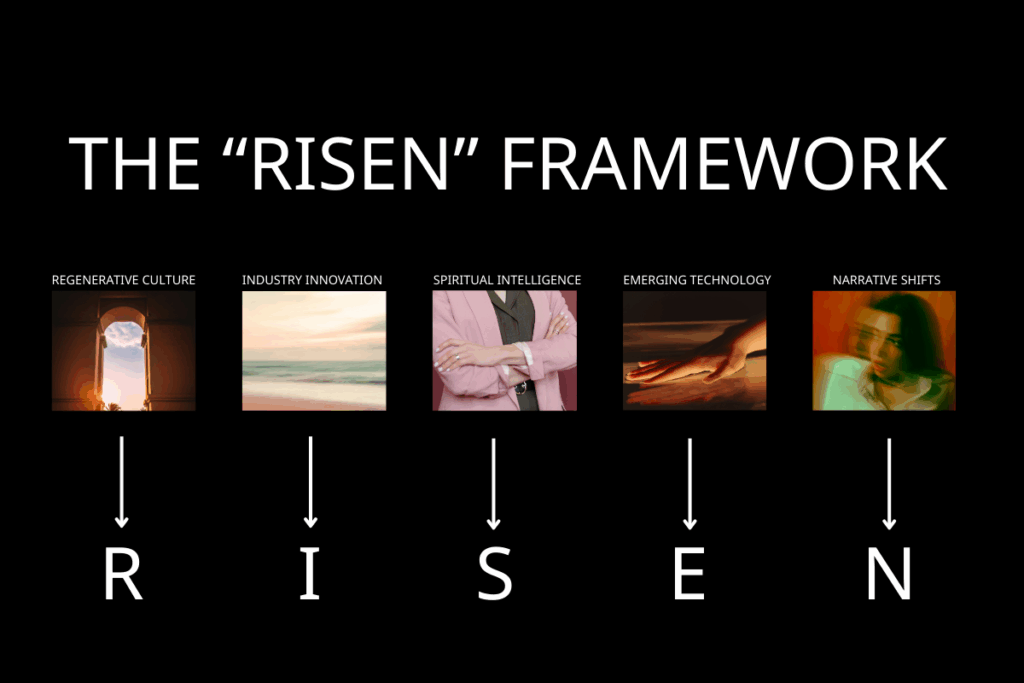
At Wild Woman Haus®, we analyze these shifts through our proprietary RISEN Framework. In 2026, the this framework evolves from interpretive lens into applied architecture.
RISEN examines:
- Regenerative Culture
- Industry Innovation
- Spiritual Intelligence
- Emerging Technology
- Narrative Shifts
These are interconnected forces shaping how business and society evolve together.
These insights extend a clear trajectory:
- 2024 revealed interdependence
- 2025 demanded interpretation within liminality
- 2026 requires intentional redirection
In 2026, brands are no longer evaluated solely on growth or relevance (OECD – Well-being Economy Framework). They are assessed on coherence—how clearly their why, what, and how align over time, and how that alignment creates resonance rather than noise. On whether their purpose is legible and if their systems align with their stated values
These insights do not stand alone. They extend a clear trajectory that began in 2024, when interdependence, care-driven systems, digital convergence, sustainability, and collaborative problem solving moved from emerging concepts into operational realities. In 2025, those forces deepened. What first appeared as signals became structural conditions that reshaped how businesses sensed, responded, and adapted.
In 2026, the shift is no longer about recognition or integration. It is about redirection. The systems identified over the past two years are now being tested for coherence, resilience, and integrity at scale. The question is no longer whether these forces matter, but how intentionally they are designed and led.
If you are new to this work, begin with our 2024 Macro Trends to understand the foundation these insights build upon, then explore how they evolved through 2025’s Macro Trends of liminal recalibration. The patterns unfolding in 2026 are the result of that progression.
(R) – Regenerative Culture in 2026 – From Polycrisis to Protopia

As the polycrisis deepens, the “polycrisis as portal” theme from 2025 intensifies into a full demand for regenerative culture in 2026. Eco-accountability shifts from urgency to emergency, requiring tangible action and rewarding ethical effort across industries.
At the same time, societal structures are being reevaluated through the lens of the Age Spectrum. Intergenerational cohesion challenges chrono-normativity and reframes stability itself (Adventures in Time & Gender, n.d.). Today, stability is emotional, ecological, and ethical, not merely financial.
Environmental pressure shifts from urgency to emergency (UN Environment Programme (UNEP) – Net Zero / Accountability frameworks). Ethical commitments are no longer symbolic. They are measured, enforced, and increasingly rewarded (World Economic Forum – ESG enforcement or regulatory reporting standards). Brands are evaluated on tangible ecological impact rather than stated intent.
Chrono-normative assumptions about productivity, relevance, and leadership are challenged. Intergenerational cohesion becomes a design consideration rather than a cultural afterthought.
Across these domains, one insight from 2025 hardens into principle. Stability is now emotional, ecological, and ethical. Financial performance alone no longer signals resilience.
Wild Woman Haus Lens: Why → What → How
The Why (North Star)
In 2026, a brand’s purpose must clearly articulate its role in regeneration. This may be ecological, social, or intergenerational. Regeneration is not an external initiative. It is the source of enduring value.
The What (Positioning and Structure)
Offerings increasingly reward ethical behavior by design. This includes products with verified ecological benefits and services that bridge generational divides. New models emerge that contribute directly to community wellbeing or environmental restoration, such as reward-based sustainability programs or intergenerational education formats.
The How (Expression and Infrastructure)
Marketing must communicate impact, not aspiration. Sensory and emotional connection reinforces credibility when paired with measurable outcomes. Community-building becomes central, inviting customers to participate in shared accountability rather than passive consumption.
What This Means for Founders in 2026
For founders, regenerative culture in 2026 is no longer optional positioning. It is operational reality. Organizations that encode care, responsibility, and continuity into their systems are better equipped to endure sustained pressure and compound trust over time.
(I) – Industry Innovation in 2026 – Biocentric Models and Values-Aligned Ecosystems

Building on 2025’s insight, “Nature in the Boardroom” evolves into a deeper mandate in 2026. Rather than adopting surface-level sustainability, businesses must now restructure governance, supply chains, and incentives.
In response to polarized consumption, brands are embedding values directly into their economic models. Ethics now outrank aesthetics, creating parallel value systems across markets (The Economist, n.d.).
Markets increasingly organize around values rather than broad appeal, making clear positioning essential for brands navigating polarized consumption (Edelman Trust Barometer (2024). Parallel economies emerge where ethics take precedence over aesthetics. Consumers align with brands that reflect their social, environmental, and political positions with clarity.
Geopolitical pressures accelerate this shift. Supply chain resilience becomes a strategic priority. Friendshoring evolves into regional alliances and localized production networks. Innovation focuses on adaptability, proximity, and trust rather than scale alone.
Together, these forces redefine what innovation means. It is no longer about speed to market. It is about alignment across systems.
Wild Woman Haus Lens: Why → What → How
The Why (North Star)
In 2026, a brand’s purpose must clearly define the values it is willing to stand behind. Market polarization makes ambiguity costly. Clear ethical positioning enables innovation that aligns operational decisions with long-term integrity.
The What (Positioning and Structure)
Industry leaders integrate ecological ethics directly into governance and supply chains. This includes structural roles that represent environmental interests and product lines designed for values-driven consumers. Regional partnerships and multilateral agreements support resilient access to markets and materials.
The How (Expression and Infrastructure)
Transparency becomes essential infrastructure. Brands verify provenance, sourcing, and impact through traceable systems (Vogue Business, n.d.). Marketing emphasizes how value alignment is built into operations, reinforcing trust among audiences who share those commitments.
What This Means for Founders in 2026
For founders, industry innovation in 2026 requires decisiveness. Organizations that embed ethics into structure rather than messaging are better positioned to navigate polarization and sustain relevance over time.
(S) – Spiritual Intelligence in 2026 – Leading from Inner Alignment Amidst Redirection

In an era defined by redirection, the Strategic Imagination identified in 2025 matures into a core leadership requirement. Spiritual intelligence—understood as depth, not doctrine—allows leaders to navigate ethical complexity with coherence. This is crucial for confronting challenges like “moral injury” (Scientific American, n.d.).
Importantly, inner alignment now determines external trust (Daniel Goleman / Emotional Intelligence at Work). Spiritual intelligence is no longer abstract or aspirational. It functions as a practical capacity. Leaders must integrate intuition, emotional awareness, ethics, and critical thinking into daily decision-making. Without this integration, complexity overwhelms strategy.
This pillar also intersects with intentional technology and creative world-building. As systems accelerate, leaders who lack internal coherence struggle to navigate ethical tension, societal pressure, and technological scale. Inner alignment becomes a stabilizing force.
Spiritual intelligence does not replace logic. It sharpens it. It allows leaders to hold ambiguity, make principled decisions, and guide organizations through uncertainty with consistency and trust.
Wild Woman Haus Lens: Why → What → How
The Why (North Star)
In 2026, a brand’s purpose must be anchored in authenticity and coherence. Leaders who embody clarity of intention create trust in unstable environments. Purpose functions as an internal compass when external signals conflict.
The What (Positioning and Structure)
Organizations that prioritize spiritual intelligence invest in emotional intelligence, ethical reasoning, and critical thinking at every level. Leadership cultures support thoughtful pace, human-centered design, and responsible technology use. Offerings reflect care for well-being and long-term impact, reinforcing values such as meaningful connection and the joy of intentional disengagement.
The How (Expression and Infrastructure)
Brand expression must reflect inner alignment in tone, content, and action. Thought leadership integrates empathy, intuition, and values without performative language. Internally, teams are rewarded for presence, discernment, and purposeful innovation rather than constant urgency.
What This Means for Founders in 2026
For founders, spiritual intelligence in 2026 is not optional. It is the capacity that allows leaders to sense direction, hold tension, and steward transformation without losing coherence.
(E) – Emerging Technology in 2026 – Deepening Trust in a Decentralized Digital Culture

The shift toward decentralized intimacy identified in 2025 deepens in 2026. Emerging technology now plays a central role in reshaping digital culture around trust, intention, and restraint.
Digital presence alone is no longer sufficient. Intentional technology becomes the new baseline. Platforms and tools are evaluated not by reach, but by their ability to support meaningful engagement, reduce harm, and respect human attention.
At the same time, digital ecosystems face growing pressure from disinformation, surveillance fatigue, and geopolitical fragmentation. Users increasingly seek clarity, consent, and the freedom to disconnect (Pew Research Center – Tech fatigue, trust, surveillance concerns). The rise of JOLO reflects a recalibration of how technology fits into daily life.
Technology also responds to global tension. Tools that enable language translation, localization, and cross-border communication become essential. Digital systems must support connection without erasing cultural context.
Together, these shifts signal a move away from scale-driven growth toward trust-centered infrastructure.
Wild Woman Haus Lens: Why → What → How
The Why (North Star)
In 2026, a brand’s purpose must include a clear commitment to using technology responsibly. Technology should serve connection, transparency, and well-being. Brands that ignore this responsibility contribute to fragmentation rather than coherence.
The What (Positioning and Structure)
Organizations implement systems that protect data integrity and user agency. This includes clear labeling of AI-generated content and safeguards that reduce misinformation. AI tools are used to support accessibility and cross-cultural communication while maintaining ethical boundaries and local relevance.
The How (Expression and Infrastructure)
Brand expression must demonstrate how technology is used with intention. Storytelling highlights real benefits, not technical novelty. Digital spaces are designed to foster depth, consent, and community rather than constant output.
What This Means for Founders in 2026
For founders, emerging technology in 2026 is not about adopting every new tool. It is about choosing systems that reinforce trust and align with human values over time.
(N) – Narrative Shifts in 2026 – World-Building for a New Polyphonic Era

The Culture as Code signal identified in 2025 accelerates in 2026. Narrative is no longer a layer applied after strategy. It becomes an active process of world-building—where brands move from transactions to movements and culture compounds through meaning.
We now operate inside a polyphonic culture. Meaning is created through micro-communities, shared references, and implicit language. IYKYK dynamics define credibility. Authenticity is earned through participation, not broadcast.
This shift requires brands to move beyond messaging. Language itself becomes design material. Storytelling expands to include speculative thinking, future-facing prototypes, and imaginative frameworks that help people orient inside uncertainty.
Consumption patterns reinforce this change. As markets polarize around values, narratives function as alignment tools. Consumers choose brands that reflect their cultural truths, not just their preferences. Story becomes the bridge between identity and economics.
In this environment, narrative coherence matters more than reach(Cultural Cognition Project). Brands that fail to articulate a clear worldview dissolve into noise.
Wild Woman Haus Lens: Why → What → How
The Why (North Star)
In 2026, a brand’s purpose must acknowledge the power of narrative to shape culture. Founders are not neutral communicators. They are authors of meaning. The clarity of your why determines the world your brand helps create.
The What (Positioning and Structure)
Organizations develop offerings that align with specific cultural codes and subcultures. Products and services reflect shared references, values, and ways of seeing the world. Speculative tools such as future scenarios and conceptual prototyping support innovation grounded in cultural insight.
The How (Expression and Infrastructure)
Brand expression becomes an act of world-building. Language is intentionally designed for the community it serves. Marketing amplifies cultural truths rather than generic promises. AI and creative systems support narrative exploration while preserving authorship and integrity.
What This Means for Founders in 2026
For founders, narrative shifts in 2026 require responsibility. Story is no longer decoration. It is infrastructure. This is the essence of brand as culture ↗, where meaning, identity, and participation shape how brands endure. Those who steward it well create coherence, belonging, and lasting cultural relevance.
Ready to Build What Comes Next?
This moment calls for more than adaptation. It calls for clarity. For founders, this is the work of moving from brand to culture ↗ — translating values into systems that build coherence over time.
If you are a founder, creative, or strategist navigating the future of health, wellness, beauty, or culture-driven commerce, the RISEN Framework offers a grounded lens for your next move.
Book a Brand Discovery Call with Tristan Thibodeau, MS, Founder and Lead Brand Strategist at Wild Woman Haus®. Together, we will examine how your brand can lead with coherence, imagination, and long-term integrity.

