
Introduction
Some brands burst onto the scene, flood the market with hype, and then vanish just as quickly. Others grow steadily, building communities and cultures that last for decades. The difference isn’t luck or timing. It’s structure, intention, and resonance.
This article explores why brands fail, and offers a framework to build one that lasts.

TL;DR — The Fastest Path to a Lasting Brand
- Brands fail when their why is unclear, their what is undefined, or their how is scattered.
- Resonance, not hype, is the currency of longevity.
- Strong brands are built on clarity, structure, and culture.
- Sustainable growth begins with a home: intellectual property, website, storytelling, and community.
- Depth beats speed: enduring brands are designed, not rushed. This is the difference between chasing marketing tactics and thinking through the architect’s mindset.
The Root Causes of Brand Failure
Unclear or Misaligned Why
Everything begins with why. When a founder’s purpose is fuzzy, every decision becomes reactive. Without clarity, a brand feels fragmented, chasing trends instead of embodying values.
Literal value (skills, deliverables) matters. But it is the abstract value, your lived experience, perspective, and story, that sets your brand apart. Without it, identity collapses into noise. Most brands burn out because they treat branding as campaigns, not culture. Every business decision shapes your brand as culture ↗.
Skipping the What in Favor of Speed
Too many entrepreneurs rush straight into the tactics of marketing: logos, Instagram posts, campaigns. But without defining what you are building, for whom, and why it matters, tactics scatter energy instead of focusing it.The what is structure. Without it, the brand becomes hollow. Instead of chasing tactics, use the Resonance Cycle framework to align why, what, and how ↗.
No Emotional Resonance or Community
Features don’t build loyalty, resonance does. Neuromarketing research has empirically evidenced that most purchasing decisions are made emotionally (Frontiers). Put simply…people buy emotionally, then justify logically. Without resonance, a brand may attract first-time buyers, but it won’t keep them.
Archetypes give brands emotional resonance (Research Gate). They transform offerings into identities and movements. Without them, even strong products fail to connect.
No Home Base or Owned Infrastructure
A brand built only on rented ground — Instagram, TikTok, LinkedIn — is fragile. Algorithms shift. Virality fades. Without a home base (intellectual property ownership, a website, lead capture, email list), there is nowhere for community to gather, deepen, and stay.
Hype Over Stewardship
Fast-moving brands often consume more than they contribute. They burn through resources, financial, creative, human, without building systems that sustain. The result? Noise instead of narrative.
Foundations of Brands That Last

Define Your Why (Purpose & Values)
Your why is both compass and anchor. It clarifies what you stand for, the unique value you bring, and the responsibility you hold.
Clarity of self begets clarity of brand.
Clarify Your What (Structure & Differentiation)
The what translates vision into form: offers, positioning, identity. It asks: What are we creating? How is it different? Who is it for?
Without a defined what, every marketing effort becomes scattershot.
Design Your How (Systems & Storytelling)
The how is not just channels, it is how humans connect emotionally with what you’ve built.
- Branding pulls (the magnet).
- Marketing pushes (the megaphone).
- Storytelling bridges the two.
When aligned, this cycle creates memory, meaning, and movement.
Build Resonance & Community
Resonance is the difference between a transaction and a movement. It’s what transforms retention into culture.
Retention is proof of resonance: when customers feel seen, they return. When they return, they contribute to culture. In fact, 65% of a company’s revenue typically comes from existing customers (Firework). And those repeat buyers aren’t just steady, they’re more valuable: returning customers spend 67% more than new ones (Business.com).
Own the Infrastructure
Lasting brands own their assets. A brand name only you can use. A website communicates clarity. Long-form content deepens authority. Email and lead capture create reciprocity. This is more than preference, it’s proven performance:
- Intellectual Property isn’t just legal protection, it’s a capital asset. IP has measurable economic value, supports licensing or sale, and strengthens brand equity and negotiating leverage. (Angel Investors Network).
- A website built for clarity and conversion is more than a digital brochure, it becomes a conversion engine. As academic research shows, pushing interface intensity too far degrades user experience faster than conversion gains (Cornell University).
- Long-Form Content helps build authority, organic reach, and lead flow. In fact, content marketing programs often yield growth in revenue well beyond their initial cost, especially when compounds over 2–3 years (First Page Sage).
- Email marketing generates an average ROI of $36 for every $1 spent, far outpacing the ROI of social media (Ian Brodie).
With this foundation, amplification (social, partnerships, press) compounds ROI instead of collapsing your marketing budget.
The Wild Woman Haus® Architecture (Concentric System)
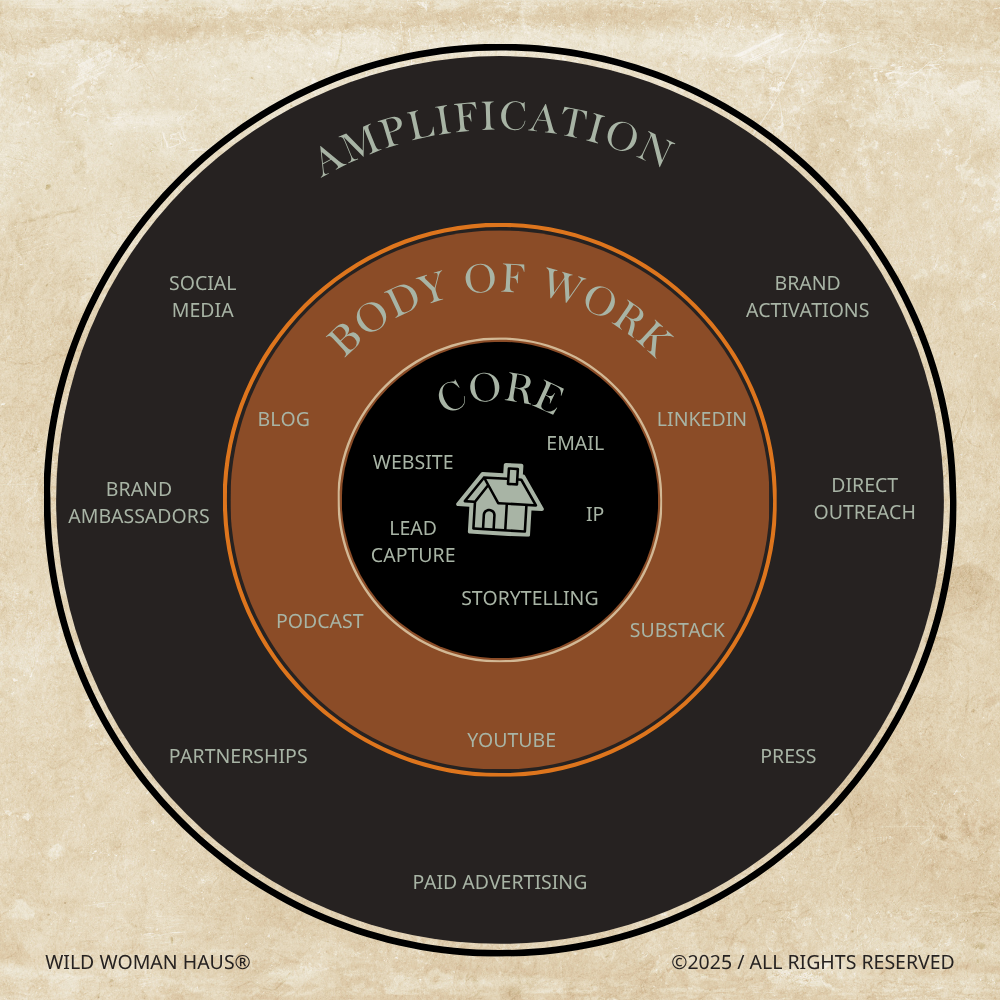
- Center (Home): Intellectual property, website, storytelling, lead capture, email.
- Surrounding Layer: Blogs, podcasts, LinkedIn, YouTube, Substack, etc.
- Amplification Layer: Social media, partnerships, press, activations.
This layered system balances agility and sustainability. Agility to respond to culture. Sustainability to endure beyond trends.
Why Most Marketing Doesn’t Work (And What to Do Instead)
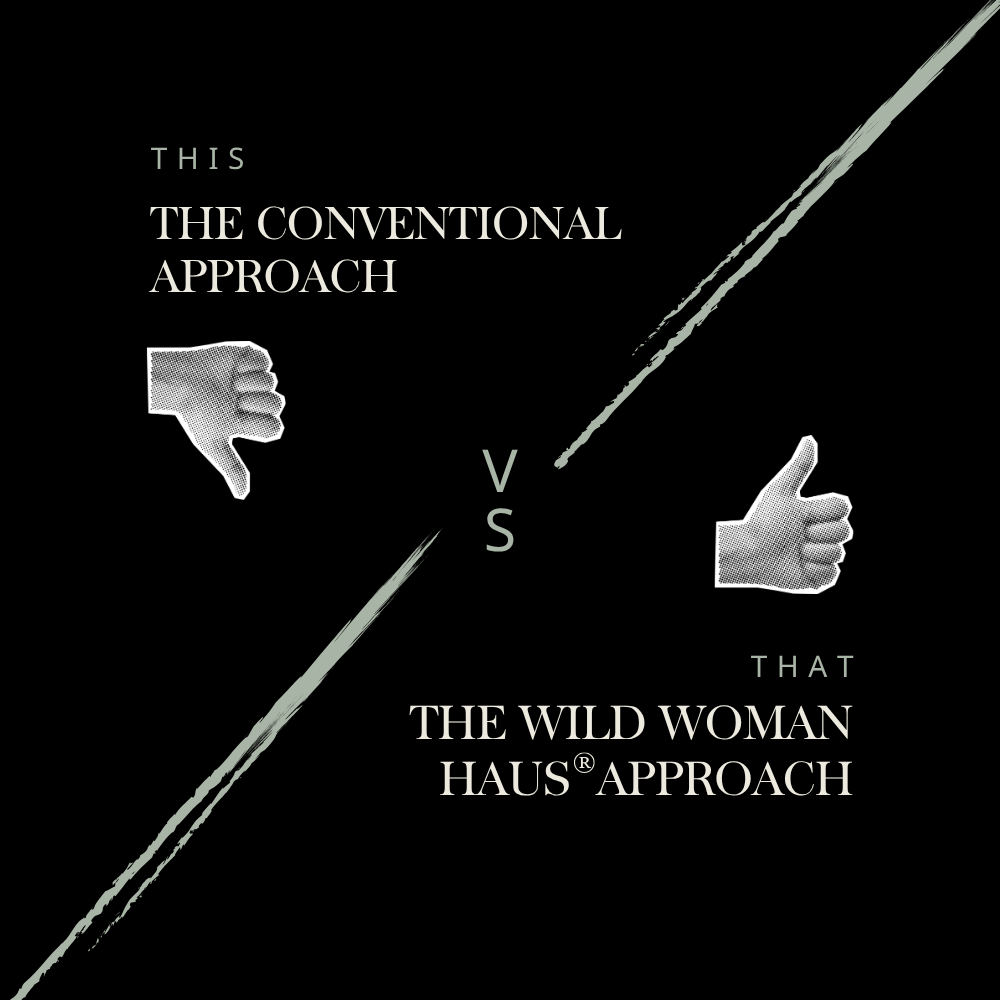
Brand A (Trend-Chasing, No Strategy): Brands that invest heavily in seasonal wellness drops or “hot topic” supplements without a grounded brand purpose. They often burn cash on influencer hype and ads, but when the trend shifts, the brand fades.
Brand B (Strategy-Led, Resonance-Focused): Ritual built its foundation around science, transparency, and daily habit. Its messaging is not about the shortest path to sale, but about what customers feel and become over time.
While exact public LTV figures aren’t disclosed, case studies show that Ritual increased retention shortly through subscription optimization (haus.io). Ritual also scales through subscription revenue and closely monitors LTV:CAC, signaling that repeat purchase behavior underpins their business model (Norwest+1). In the crowded supplement category, their story-driven transparency and narrative positioning help them stand out, evidence suggests that consumers stay when they trust the brand as well as the product.
Checklist — Are You Building a Brand That Lasts?
Ask yourself:
- Do I have clarity on my why (purpose + values)?
- Have I defined my what (offers, positioning, audience)?
- Is my how clear (storytelling, systems, channels)?
- Do I have a strong home (intellectual property, website, email list, long-form content)?
- Is my brand resonant (emotional identity, archetype, community)?
- Am I focused on retention, not just acquisition?
If you answered “no” to more than one, your brand may be at risk of burnout. And the cost of neglecting retention is steep: even a 5% lift in customer retention can increase profits by 25–95% (VWO).
Common Misconceptions to Avoid
- “Brand = visuals.” (Logos and colors are only the surface.)
- “Speed beats depth.” (Speed may create noise, but depth creates culture.)
- “Social is enough.” (Social amplifies, but cannot sustain.)
“Acquisition matters more than retention.” (In truth, retention fuels growth.)
30-Day Action Plan
- Week 1: Map your why (literal + abstract value).
- Week 2: Define what you build (offers, positioning, audience).
- Week 3: Audit your home (intellectual property, website, lead capture, email).
- Week 4: Establish story pillars, create your first long-form piece, and distribute.
FAQ
How do I know if my brand’s why is strong?
If you can explain it in one sentence, and it resonates with your community, it’s strong.
Can a brand recover after confusion?
Yes. By realigning with why → what → how, then rebuilding trust through consistent storytelling.
Is speed ever good?
Speed creates visibility. Depth creates longevity. Both matter, but depth sustains.
How do I choose an archetype?
Start with your audience’s deepest desire: safety, freedom, belonging, mastery, joy. Align your story to that.
What owned assets are non-negotiable?
A clear website, a lead capture system, and an email list. These secure longevity.
Conclusion + CTA
Every brand decision is a cultural act. The way you price, serve, and speak ripples into identity, reputation, and loyalty.
Brands fail when they rush, scatter, or consume more than they contribute. Brands last when they build with clarity, resonance, and stewardship.
At Wild Woman Haus®, we help founders design brands as homes, rooted in clarity, alive with culture, and built to endure. If you’re ready to build with intention, here’s how to start building your brand as culture ↗.
If you want to explore how culture-driven brands are intentionally designed, start with The Architect’s Mindset or dive deeper into the Resonance Cycle framework.
→ Ready to build a brand that lasts? Download the WWH Services Guide or book a Discovery Call today.

