

As 2025 unfolds, the forces exposed in 2024 have not stabilized. They have clarified.
What once appeared as disruption now functions as signal.
The volatility of recent years revealed the limits of prediction-based strategy. Forecasting alone no longer offers stability. Instead, businesses are being asked to develop interpretive capacity: the ability to sense patterns, contextualize risk, and respond with coherence rather than reaction. This kind of leadership reflects what we call the architect’s mindset ↗, designing businesses with structural awareness so they can endure uncertainty rather than react to it.
If 2024 made systems visible, 2025 asks leaders to make meaning inside them.
Why We Study Macro Trends at Wild Woman Haus®
At Wild Woman Haus®, we publish annual Macro Trends reports to answer a different kind of business question.
Not what’s trending next, but what conditions are shaping how business must be designed to endure.
Macro trends operate upstream of tactics. They shape consumer behavior before campaigns exist, influence markets before products launch, and determine whether a strategy compounds or collapses over time. When founders focus only on short-term signals, they risk optimizing for relevance while undermining resilience.
These reports exist to help founders, creatives, and strategists:
- See beyond surface-level trends into structural forces
- Understand how cultural, technological, ecological, and economic shifts interact
- Design brands and systems that align with reality, not wishful forecasts
Each year’s report maps the architecture of global business: the invisible pressures, constraints, and opportunities that shape what can be built, sustained, and trusted.
This is not trend prediction.
It is strategic orientation.
The Central Theme of 2025: Liminality
2025 occupies a liminal space: a threshold between what no longer works and what has not yet fully formed.
Interdependence remains the underlying condition, but the work has shifted. The question is no longer whether systems are connected, but how responsibility, resilience, and meaning are designed within those connections.
This year is defined by ambiguity. By transition. By the discomfort of operating without resolution.
Leaders are being asked to metabolize disruption rather than rush past it. To hold tension without collapsing into urgency. To interpret complexity without forcing premature certainty.
Introducing the RISEN Framework
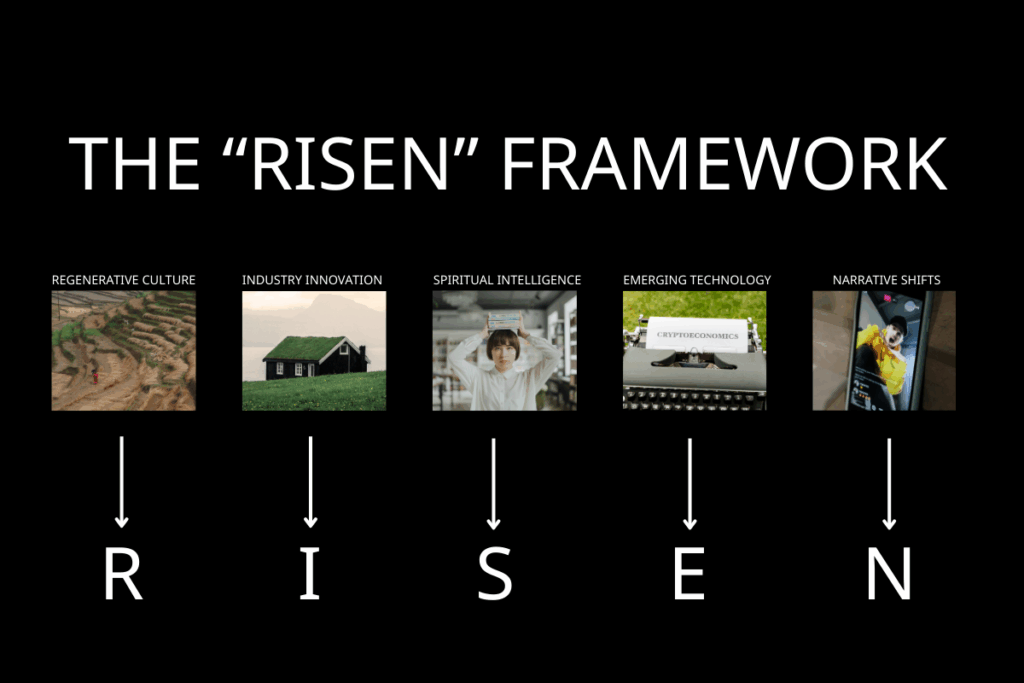
At Wild Woman Haus®, we analyze these shifts through our proprietary RISEN Framework.
RISEN examines:
- Regenerative Culture
- Industry Innovation
- Spiritual Intelligence
- Emerging Technology
- Narrative Shifts
These are interconnected forces shaping how business and society evolve together. In 2025, RISEN functions as an interpretive lens, helping leaders orient themselves inside liminality rather than resist it.
The signals explored this year do not predict the future.
They describe the conditions being formed now, while outcomes remain unsettled.
These insights do not emerge in isolation. They build directly on the macro trends identified in 2024, where interdependence, care-driven systems, digital convergence, sustainability, and collaborative problem solving reshaped how businesses operated under pressure. What has changed in 2025 is not the presence of these forces, but their depth. What appeared as signals last year now functions as structure.
New here? Start with our 2024 Macro Trends to understand the foundation these shifts build upon.
(R) – Regenerative Culture – From Collapse to Coherence

In 2024, interdependence emerged as the central organizing trend for global systems. In 2025, that interdependence is being tested by sustained disruption, forcing brands to move from reactive resilience toward regenerative coherence.
The defining condition of the current era is the polycrisis. Climate instability, economic volatility, public health strain, and social fragmentation are no longer isolated. These disruptions now converge and compound across global systems. This condition is not theoretical. Research from Edelman (2022) and Gallup (2022) supports the same conclusion. Trust is eroding. Institutions feel brittle. Uncertainty is now the default operating environment.
Brands are not exempt. They are cultural participants. Their decisions either amplify fragmentation or help restore coherence. A recalibration is underway for 2025. And it centers on what stability means.
Empathy is becoming infrastructure. Emotional intelligence is moving into operations. Chewy offers a clear example. The company sends handwritten notes or flowers to grieving customers. These gestures signal care at the system level. WGSN frames this as part of a broader shift toward care-led brand systems. In these systems, emotional awareness is designed into the customer experience.
Responsibility is becoming operational. Supply chains are becoming ethical questions. Friendshoring reflects that change. It is the relocation of supply chains to geopolitically aligned nations. As noted by The International Journal for Multidisciplinary Research (2020), the driver is not only efficiency. The deeper signal is values-aligned commerce. Accountability is becoming part of strategy.
Preparedness is becoming imaginative. Wimbledon’s pandemic insurance is a useful reference point. It was once seen as excessive. It now reads as anticipatory leadership. Taleb describes why this matters. Organizations that plan for uncertainty respond better to black swan events (Kahneman, 2007). Foresight is becoming a leadership competency.
The throughline is direct. Stability is no longer defined by financial performance alone. It is increasingly emotional, ecological, and ethical.
Founder bridge: For founders navigating 2025, this trend shows up as a systems decision. Where does care live in your operations. What risks are you building for. What values are enforced when pressure rises. In a polycrisis economy, coherence becomes a competitive advantage.
Regenerative culture does not eliminate chaos. It designs inside it. It treats volatility as structural. The goal is continuity. Brands leading here are not reacting to crisis. They are building coherence within it. These 2025 macro trends reveal how disruption is no longer episodic, but systemic.
(I) – Industry Innovation – Biocentric Business Models

Environmental urgency was already reshaping business strategy in 2024. Macro trends for 2025 show how sustainability has moved beyond commitment statements and into governance itself, redefining how innovation is measured and led.
The environmental crisis is no longer background noise. It is the context in which strategic decisions are made. Record-breaking wildfires, ecological degradation, and resource insecurity are reshaping how organizations define risk, responsibility, and growth.
As a result, some businesses are rethinking their relationship with the natural world at the governance level. Nature is no longer treated as an externality. It is beginning to be recognized as a stakeholder, not symbolically, but legally and structurally.
A clear example comes from the UK-based beauty brand Faith in Nature. The company appointed a non-executive ecological director with a formal mandate to represent the interests of the natural world in board-level decisions (Lawyers for Nature, 2022). This move established legal precedent. It also signaled a shift away from performative sustainability toward embedded accountability.
The implications are significant.
Regeneration is no longer positioned as a future ambition. It is becoming a baseline expectation. Ecological stewardship is moving out of marketing narratives and into governance frameworks. Environmental ethics are increasingly treated as operational requirements rather than brand positioning tools.
This shift reflects a broader recalibration of innovation itself. Growth is no longer defined solely by expansion or extraction. Instead, it is being reframed through continuity, stewardship, and long-term viability. Businesses are being asked to account for ecological impact at the same level as financial performance.
Founder bridge: For founders, this trend raises a structural question. Where does the environment sit in your decision-making hierarchy. Is it treated as a constraint, a cost, or a stakeholder. As regulatory, cultural, and ecological pressures converge, governance models that integrate ecological accountability are becoming a source of resilience rather than limitation.
This movement is not about innovation for its own sake. It represents a return to relationship. Growth is being redefined to align with guardianship. Profit is no longer defensible if it accelerates planetary collapse.
(S) – Spiritual Intelligence – Leading from Within

One of the quieter macro trends 2025 points to a recalibration of leadership itself. In a world saturated with information yet starved for wisdom, spiritual intelligence is emerging as a critical leadership capacity. This is not about religion. It is about depth. It reflects the ability to integrate emotion, intuition, creativity, and values into decision-making.
Described as strategic imagination, leadership now relies on the ability to synthesize not only data, but direction from ambiguity. Leaders are increasingly required to navigate uncertainty without complete information. As a result, inner coherence has become a strategic asset. Last year, we identified a shift away from urgency-driven work toward more sustainable rhythms. In 2025, this recalibration extends inward, elevating spiritual intelligence and strategic imagination as leadership competencies rather than personal traits.
This form of intelligence is well illustrated through the work of creativity scholar Ruth Noller. She framed creativity as a dynamic equation:
Creativity = Knowledge × Imagination × Evaluation × Attitude
Creativity is not limited to idea generation. It emerges from the interaction of what we know, what we can envision, how we assess relevance, and the mindset we bring to uncertainty. Knowledge provides grounding. Imagination expands possibility. Evaluation ensures responsibility. Attitude determines resilience and follow-through.
Consider a practical example. An entrepreneur responding to climate concerns may develop biodegradable, refillable packaging. They apply knowledge of materials and supply chains, and use imagination to design something functional and desirable. They evaluate cost, scalability, and impact. All the while bringing an attitude of experimentation rather than fear.
Each element amplifies the others. The outcome is not incremental innovation. It is transformation.
Leaders who embody this equation are better equipped to navigate disruption with integrity. Their strategies are not reactive. They are informed by empathy, clarity, and internal alignment.
Founder bridge: For founders, this trend highlights a quieter form of leadership advantage. Strategic imagination does not replace analysis. It complements it. As markets become more volatile and signals more complex, the ability to hold uncertainty while making principled decisions becomes a differentiator. Inner alignment increasingly shapes external coherence.
In 2025, the call is not simply to lead with insight. It is to lead with alignment. The world does not need more reactive branding. It needs leaders capable of sensing, holding, and stewarding transformation.
(E) – Emerging Technology – Redesigning Digital Culture

As Gen Z reshapes the internet, a clear shift is underway. Digital culture is moving away from mass platforms and toward smaller, self-organized ecosystems. TikTok has surpassed Google as a search engine (Hanson, 2024), but its significance extends beyond usage metrics. It reflects the decentralization of identity, influence, and narrative authority.
The digital convergence highlighted in 2024 has continued, but with new consequences. What once focused on access and efficiency now raises deeper questions around intimacy, consent, and emotional ethics in digital spaces.
In this fragmented environment, intimacy and visibility are being renegotiated.
FOLO, or fear of logging off, highlights the strain of always-on digital presence. Intimacy is increasingly mediated through platforms built on surveillance and performance. At the same time, the rise of “algospeak,” or coded language used to bypass moderation, shows how communities adapt to algorithmic constraints while protecting expression (Cambridge, 2025).
These patterns point to deeper cultural shifts.
Mass appeal is losing dominance. Specificity, subculture, and consent are gaining relevance. Platforms such as decentralized autonomous organizations, including Friends With Benefits, are experimenting with new models of belonging. Participation is selective rather than universal. Identity is relational rather than performative.
The digital frontier is no longer defined by reach alone. Depth, transparency, and trust are becoming critical variables. Digital spaces are increasingly understood as emotional environments, not neutral tools.
Founder bridge: For founders, this shift reframes how digital strategy is evaluated. Scale without resonance is no longer sufficient. Communities expect intentional engagement, clear values, and respect for boundaries. Digital presence is being judged less by visibility and more by relational integrity.
To remain relevant in this landscape, brands must listen more than they broadcast. Digital culture is no longer a distribution channel alone. It is an ethical and emotional terrain that shapes trust, loyalty, and long-term relevance. These global macro trends suggest a shift from scale-driven platforms to trust-driven ecosystems.
(N) – Narrative Shifts – Meaning in the Meme Era
In 2024, brands began to recognize culture as infrastructure where identity, storytelling, and community shape how businesses operate and endure. In 2025, culture operates as code, shaping meaning through shared language, micro-communities, and contextual storytelling rather than mass narratives.
Narratives no longer flow from centralized media institutions. Culture now moves through many voices at once. We live in a polyphonic landscape where memes, remixes, and micro-trends shape how meaning is created and shared.
Global storytelling has shifted accordingly. From Netflix’s Squid Game to genre-defying TikTok formats to Spotify’s hyper-niche playlists, cultural influence is no longer driven by dominance. It is driven by emotional resonance that travels across borders and platforms (The Economist, 2025).
Several signals define this transition.
The era of mass media monoculture is ending. The new cultural currency is IYKYK. If you know, you know. Meaning is increasingly contextual and community-based. Fashion houses such as Balmain have responded by treating entertainment as a core strategic function. In this model, culture is not a campaign. It operates as code that shapes perception and belonging (Kholova, 2022).
Research supports this shift. Studies from Yale Law School’s Cultural Cognition Project show that shared cultural meaning often shapes behavior more effectively than data alone (Yale Law School, 2022). People respond to stories that affirm identity, values, and worldview. Information without context rarely changes behavior.
These dynamics place new responsibility on brands.
Founder bridge: For founders, narrative now functions as an environment rather than a message. Storytelling choices shape who feels included, who feels seen, and who feels excluded. Cultural relevance is no longer achieved through volume. It is built through discernment and respect for nuance.
Brands must ask harder questions. Which cultural truths are being amplified. Which communities are being acknowledged rather than extracted from. How does brand storytelling provide coherence rather than noise in an already saturated landscape.
In 2025, narrative is not a tactical lever. It is a terrain. Brands that navigate it well will treat story not as strategy, but as stewardship. Taken together, these business macro trends in 2025 redefine how meaning is produced and shared.
Conclusion: From Forecasting to Future-building
The RISEN Framework does more than identify trends. It reveals the forces shaping them. It allows us to move beyond prediction and toward participation.
Leadership in this moment requires integration. Regeneration must sit alongside innovation. Logic must coexist with intuition. Scale must be balanced with specificity. Strategy must be grounded in purpose.
This is not a call to chase what is emerging. It is a call to discern what is enduring.
Rather than asking what is trending, the more useful question is what is true. Rather than asking what sells, the more consequential question is what serves.For founders exploring how these macro shifts translate into brand strategy, the next step is understanding how businesses evolve from brand to culture ↗. The future is not something that arrives fully formed. It is shaped through decisions, systems, and narratives repeated over time.
Futurebuilding demands intention. It requires founders and leaders to move with awareness rather than urgency. The choices made now will determine which systems endure and which dissolve.
Ready to Build What Comes Next?
This moment calls for more than adaptation. It calls for clarity.
If you are a founder, creative, or strategist navigating the future of health, wellness, beauty, or culture-driven commerce, the RISEN Framework offers a grounded lens for your next move.
Book a Brand Discovery Call with Tristan Thibodeau, MS, Founder and Lead Brand Strategist at Wild Woman Haus®. Together, we will examine how your brand can lead with coherence, imagination, and long-term integrity.

