
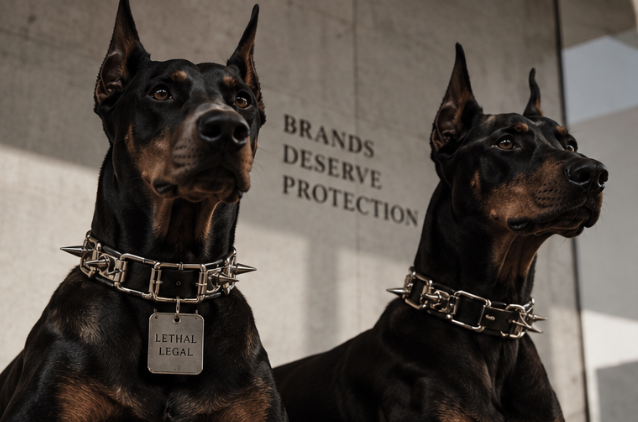
The Brand Strategy Challenge for Boutique Law Firms: When the Founder Becomes the Brand
Brand strategy for boutique law firms becomes particularly important when the founder who built the firm’s reputation also becomes central to its ability to scale.
By late 2022, Chandler J. Esq. had already built something many founders spend years trying to achieve: a recognizable personal brand, an engaged audience, and a successful legal practice centered around trademark and intellectual property protection.
But the business was evolving beyond the structure that had originally supported its growth.
Chandler was the brand.
Clients knew Chandler. They followed Chandler. They trusted Chandler. Much of the business’s authority, visibility, and customer relationship was concentrated around her personal identity.
That model had successfully supported an attorney-led personal brand. Chandler’s vision, however, was expanding toward something larger: a boutique law firm capable of supporting a broader team, deeper client relationships, and an evolving ecosystem of legal services.
The strategic challenge wasn’t simply to rebrand the business.
It was to answer a much harder question:
How do you move the equity of a successful personal brand into a company brand without abandoning the trust that made the business valuable in the first place?
That became the foundation of our work.
Client Overview:
- Primary Topic: Brand Strategy for Boutique Law Firms
- Client: Chandler J. Esq. / Lethal Legal®
- Brand Channels:
- Instagram – The Lethal Lawyer
- LinkedIn – Chandler J. H.
- Website – https://yourlethallegal.com/
- Industry: Legal & Business Protection
- Niche: Intellectual Property / Boutique Law Firm
- Business Type: B2B Professional Services
- Original Engagement: Late 2022 through Q1 2023
- Scope: Brand Strategy, Market Positioning, Messaging Strategy, Offer Positioning, Marketing Strategy, Brand Transition Strategy, Website Strategy & Preliminary Copy Direction

The Strategic Objective: Building a Boutique Law Firm Beyond the Founder
Wild Woman Haus® was brought in to help Chandler translate the equity she had already built as Lawyer Chandler J. into a broader firm identity under Lethal Legal®.
The objective was not to erase Chandler from the brand.
It was to create enough structure around the business that Chandler could exist within the brand rather than carrying the entire brand herself.
Together, we worked to:
- clarify the positioning of the emerging boutique law firm;
- translate Chandler’s existing reputation, personality, and approach into a broader company identity;
- integrate her existing Business Bodyguards language into a cohesive positioning system;
- clarify and position the firm’s evolving service ecosystem;
- develop strategic messaging for the new company identity;
- create marketing and launch strategy for introducing Lethal Legal® to Chandler’s existing audience;
- map the customer-facing touchpoints that needed to transition from the personal brand to the firm; and
- translate the positioning into website strategy, content architecture, messaging, and preliminary copy.
The goal was continuity without total founder dependency: preserve the equity Chandler had already built while creating room for Lethal Legal® to accumulate equity of its own.
Phase 1: Building a Brand Strategy for a Growing Boutique Law Firm
The first stage was understanding what Lethal Legal® needed to mean in the market.
Traditional legal brands often lean heavily on professionalism, credentials, and expertise. Those signals matter, but they can also produce firms that feel interchangeable, intimidating, or disconnected from the entrepreneurs they serve.
Chandler already possessed something different.
Her approach to law was direct, modern, accessible, educational, and centered around helping entrepreneurs understand legal protection as part of building a serious business, rather than something to consider only after a problem occurred.
She had also already developed language that captured that philosophy:
Business Bodyguards.
Wild Woman Haus® did not create that language.
Our role was to recognize its strategic potential and help Chandler expand it into a broader positioning and messaging system capable of supporting Lethal Legal®.
The idea reframed the relationship between attorney and client.
A business bodyguard doesn’t simply file paperwork.
A bodyguard anticipates risk.
A bodyguard protects what is valuable.
A bodyguard stays close as the stakes increase.
That gave us a strategic bridge between Chandler’s existing approach to legal services and the firm identity she was building.
Instead of communicating legal protection exclusively through isolated transactions, Lethal Legal® could begin representing an ongoing relationship between growing businesses and the legal professionals responsible for helping protect what they were building.

Phase 2: Brand Strategy for Transitioning From Personal Brand to Boutique Law Firm
Changing the brand identity was only one part of the transition.
The more complicated work involved changing what the business represented without abandoning the founder equity that already existed.
The transition needed to preserve the personality, accessibility, education, and trust associated with Lawyer Chandler J. while creating another source of authority:
Lethal Legal® itself.
The strategic movement was from a brand story centered primarily around:
Chandler protects your business
toward a larger idea:
Lethal Legal® is a firm of Business Bodyguards protecting what you’re building.
That distinction created room for additional attorneys, expertise, services, and client relationships to eventually exist under one recognizable company brand.
The goal wasn’t to make Chandler less valuable.
It was to make the company capable of becoming valuable alongside her.
This is where brand architecture becomes especially important. The objective isn’t simply to create a new identity, but to establish a structure that can accommodate the company’s future growth without sacrificing the equity that made it valuable in the first place.
The positioning therefore explored the tension between two qualities that legal brands often struggle to hold simultaneously:
Approachable to the client. Lethal to the threat.
That gave the emerging brand room to retain the personality and accessibility associated with Chandler while developing the authority expected of a serious legal partner.

Phase 3: Positioning the Business Model for Deeper Client Relationships
The brand transition was happening alongside another evolution inside the business.
Chandler was developing a broader ecosystem of legal services beyond individual trademark filings.
This distinction is important:
Wild Woman Haus® did not invent the underlying business model or service architecture.
Those services, ideas, and business ambitions belonged to Chandler.
Our role was to help develop, clarify, organize, position, and market the evolving offer ecosystem so customers could more easily understand how the different services related to their needs and to the larger Lethal Legal® promise.
That included strategic work around offers such as trademark filing services, subscription-based legal support, VIP experiences, monitoring, and other forms of ongoing legal protection.
The branding implications were significant.
If the market continued to understand the business primarily as a place to purchase a trademark filing, customers would continue perceiving Lethal Legal® through the lens of a single transaction, regardless of how much the business itself evolved.
The larger positioning therefore connected the services to a broader customer need:
protecting the business as it grows.
Rather than asking only:
“How do we sell more trademark filings?”
we could ask:
“What kind of relationship should a growing business have with its Business Bodyguards?”
That question created room for the business model and brand positioning to reinforce one another.

Phase 4: Translating the Strategy Across the Brand Experience
Once the strategic direction was established, the transition needed to become visible across the customer experience.
Wild Woman Haus® mapped the customer-facing ecosystem that would need to transition from Lawyer Chandler J. toward Lethal Legal®, including:
- social media identity and handles;
- website and domain;
- email identity;
- client communications;
- contracts and agreements;
- invoicing and payment systems;
- marketing materials;
- email marketing;
- social content; and
- launch communications introducing the firm.
This was a brand migration roadmap. Some of these touchpoints required implementation by Chandler, her team, or other collaborators, rather than direct execution by Wild Woman Haus®.
These transitions also reinforced the importance of a strong brand foundation. A company’s website, domain, email identity, and customer-facing systems are more than administrative details. They form part of the infrastructure through which a business establishes credibility, maintains continuity, and develops equity beyond its founder.
Translating the Strategy Into the Website
The website became one of the most important places to translate the repositioning.
Wild Woman Haus® developed website strategy, content architecture, strategic messaging, and preliminary website copy across key pages and customer journeys.
The purpose was to make sure the website could communicate the emerging firm identity, explain the service ecosystem, establish the new brand story, and progressively shift customer recognition from the founder alone toward Lethal Legal®.
The preliminary work included strategic direction and copy development for areas such as the homepage, About page, Services, Contact, Press, blog, testimonials, calls to action, offer descriptions, FAQs, and customer journey.
Wild Woman Haus® did not write the final published website copy.
Final website copy was later developed and refined by Kaili Meyer of Reveal Studio Co., while Kierra Anderson of Identity Haus translated the strategic direction into Lethal Legal®’s visual identity and website design.
This is where creative direction becomes essential: translating strategic positioning into a cohesive expression across messaging, visual identity, and customer experience. For Lethal Legal®, that meant ensuring the firm’s emerging identity could communicate both the authority of a legal practice and the bold, approachable personality that made Chandler’s original brand distinctive.
This collaborative structure allowed the positioning developed through the strategy process to move from business thinking into language, identity, and digital experience without misrepresenting the distinct role each collaborator played.

Phase 5: Building a Marketing Strategy Around the Boutique Law Firm
The marketing strategy faced the same challenge as the brand strategy.
Chandler already had attention.
The objective wasn’t simply to generate more of it.
The opportunity was to begin converting some of that founder attention into recognition and equity for Lethal Legal®.
Wild Woman Haus® developed launch and marketing strategy around the transition, including messaging designed to explain why the business was changing, introduce the Lethal Legal® identity, preserve audience trust, and establish expectations around what the new firm represented.
The work also included strategy around:
- educational intellectual property content;
- social storytelling;
- offer-specific marketing;
- email marketing;
- case-driven content;
- customer outcomes and pain points;
- calls to action; and
- messaging around the expanded scope of the firm.
Existing concepts such as The Weekly Steal provided another opportunity to continue the accessible legal education Chandler’s audience already valued while increasingly associating that expertise with Lethal Legal®.
The founder didn’t need to disappear for the firm to gain equity.
Founder equity could become the bridge into company equity.

The Strategic Shift: From Personal Brand to Boutique Law Firm
The most important outcome of the engagement wasn’t a logo, website, social handle, or campaign.
It was the creation of a larger strategic container for the business.
Before the repositioning
Lawyer Chandler J. represented a highly recognizable attorney-led personal brand whose reputation, expertise, content, and customer relationships were closely connected to Chandler herself.
Through the repositioning
Lethal Legal® began developing a company identity capable of representing a team, a broader ecosystem of legal services, and client relationships that did not necessarily need to begin and end with one individual.
That distinction matters far beyond this particular case study.
Founder visibility can create enormous early-stage brand equity. But as a company grows, concentrating nearly all trust and recognition around one person can eventually limit what the brand is capable of representing.
The solution isn’t necessarily to remove the founder.
It’s to create enough company equity that the founder has a choice.

What This Brand Strategy for Boutique Law Firms Demonstrates
The Lethal Legal® repositioning illustrates a challenge that extends well beyond the legal industry.
A successful founder can become one of a company’s greatest assets while simultaneously becoming one of the structures the company eventually needs to grow beyond.
Scaling therefore requires more than hiring people or adding offers.
The brand itself needs enough capacity to hold the evolution.
For founder-led boutique firms, that can require aligning:
Founder Equity → Firm Position → Offer Architecture → Customer Relationship → Brand Experience
When those elements begin reinforcing one another, the company can accumulate equity beyond the individual who started it without sacrificing the value that individual created.
And this is where the Lethal Legal® case becomes particularly interesting.
Because our original strategic engagement took place from late 2022 through Q1 2023, with elements of the website and implementation work continuing afterward.
The brand did not stop evolving when Wild Woman Haus® left the room.

Where Is Lethal Legal® Now? The Brand Strategy and Boutique Law Firm in 2026
Three years later, Lethal Legal® gives us an opportunity to examine brand strategy for boutique law firms longitudinally.
Not by claiming everything the business subsequently built as an outcome of our work.
But by asking a much more interesting question:
What happens after the strategy leaves the strategist’s hands?
Which strategic ideas remained useful?
Which ones changed?
How did the service ecosystem evolve?
How did Chandler’s role evolve?
Where did the Lethal Legal® team take the business beyond the original engagement?
And did the company continue becoming capable of holding equity beyond its founder?
1. The Founder-to-Firm Transition Continued
The Business Bodyguards concept Chandler brought into the original work remains particularly interesting in retrospect.
During the engagement, Wild Woman Haus® helped integrate the concept into a larger strategic system around protection, ownership, risk, growth, and the ongoing legal needs of entrepreneurs.
That created substantially more territory than positioning the business exclusively around “trademark attorney.”
And this demonstrates something important about distinctive positioning:
A strong strategic idea shouldn’t merely produce a tagline.
It should create a world the business can continue building inside.
2. “Business Bodyguards” Became Part of a Larger Brand World
The Business Bodyguards language Chandler originally brought into the repositioning remains particularly significant when looking at the brand today.
In 2023, Wild Woman Haus® helped integrate that concept into a broader market position: legal protection wasn’t simply an administrative transaction completed when someone needed a trademark filed. It could represent an ongoing relationship between a business and the legal team responsible for protecting what that business was building.
That idea created significantly more territory for Lethal Legal® to occupy.
Instead of being confined to trademark attorney, the brand could speak about protection, threats, ownership, growth, risk, and the broader legal infrastructure surrounding entrepreneurship.
This is one of the reasons distinctive positioning matters.
A strong position doesn’t simply give a business a clever tagline.
It creates a world the brand can continue building inside.
3. The Service Ecosystem Grew Beyond a Single Legal Transaction
The evolution of Lethal Legal® also reinforces one of the questions present in the original strategy:
What happens when the customer needs more than one thing?
Entrepreneurs don’t stop encountering legal needs after filing a trademark.
Their businesses grow. Their intellectual property expands. New agreements become necessary. New risks emerge. Their assets become more valuable and therefore more important to protect.
Wild Woman Haus® did not create the business architecture Lethal Legal® ultimately developed.
Our role during the original engagement was to help develop, clarify, organize, position, and market the emerging service ecosystem so customers could understand the firm as something larger than a single legal transaction.
What Chandler and her team subsequently added, changed, refined, or removed belongs to the evolution of their business after our engagement.
And that is precisely the point.
Strategy should give a business room to evolve without requiring it to remain frozen in the version the strategist originally encountered.
4. The Brand Matured Without Becoming Generic
As founder-led companies mature, they often encounter another identity problem.
They professionalize and accidentally sterilize themselves.
The personality, cultural references, language, and point of view that originally made the founder distinctive can get replaced by the polished sameness of the category they’re entering.
But brand culture isn’t something a company should abandon as it matures. It is expressed through the decisions, behaviors, and experiences that shape how people perceive the business. For Lethal Legal®, the challenge was to translate Chandler’s distinctive personality into a firm-level identity without losing the qualities that made her original brand recognizable.
For Lethal Legal®, the strategic tension was different:
How can a boutique law firm gain institutional authority without surrendering the personality and accessibility that made the founder-led business compelling?
The brand’s evolution since the original engagement belongs to Chandler and the collaborators and team members who continued shaping it.
What is notable in 2026 is that Lethal Legal® still occupies a recognizably unconventional space within the legal category.
It can communicate expertise while retaining directness, edge, accessibility, personality, and cultural fluency.
The objective was never simply to make Chandler’s business look more like a law firm.
It was to help create a law firm brand capable of developing a recognizable identity of its own.
5. What Endured Was Bigger Than a Campaign
Looking back from 2026, the useful question isn’t whether every recommendation from the original engagement survived unchanged.
It shouldn’t have.
Businesses evolve.
Markets change. Teams grow. Offers change. Founders change. Customers reveal new needs. New opportunities emerge.
The more meaningful measure is whether the underlying strategic architecture gave the business somewhere to go.
Several ideas explored during the original repositioning remain useful lenses for understanding Lethal Legal®’s evolution:
Founder → Firm
Trademark Transaction → Broader Business Protection
Individual Attorney → Firm-Level Expertise
Personal Brand Equity → Company Brand Equity
Single Service → Deeper Legal Relationship
These weren’t predictions about exactly what Lethal Legal® would become.
They were strategic directions designed to create a larger container.
What Chandler and the Lethal Legal® team chose to build inside that container over the following years belongs to them.
And that may be one of the clearest demonstrations of what good brand strategy is supposed to do.
6. Brand Strategy Should Create Capacity, Not Confinement
This is ultimately why we’re revisiting this case study three years later.
A brand strategy shouldn’t tell a business exactly what it must look like forever.
It should create capacity.
Capacity for new people.
Capacity for new offers.
Capacity for the founder’s role to change.
Capacity for customers to change.
Capacity for the market to change.
Capacity for the company to become something nobody could completely prescribe when the strategy was originally developed.
The strongest brands retain a recognizable center while allowing the structures around that center to evolve.
Lethal Legal® in 2026 isn’t simply the brand Wild Woman Haus® worked on in 2023.
It is what Chandler and her team built next.
Wild Woman Haus® helped clarify the positioning, organize and position the emerging offer ecosystem, integrate Chandler’s existing Business Bodyguards concept into a broader strategic system, develop messaging and marketing direction, map the founder-to-firm transition, and establish strategic direction for how that story could move through the website and customer experience.
Kaili Meyer, Kierra Anderson, Chandler, and others subsequently brought their respective expertise to the expression and continued development of the brand.
And from there, Lethal Legal® kept evolving.
That is exactly what strategy should make possible.

Is Your Business Outgrowing the Brand That Built It?
Sometimes growth creates a strange problem.
The business you have today no longer fits comfortably inside the brand that helped you build it.
Your offers have changed. Your team has expanded. Your vision has gotten bigger. Maybe customers still associate the business entirely with you, or the brand you’re presenting to the world simply no longer reflects the company you’re actually building.
You don’t necessarily need to start over. You may need a stronger architecture for what comes next.
At Wild Woman Haus®, I work with founders to clarify their positioning, strengthen the structure beneath their brands, and build something capable of holding the business they’re becoming, not just the business they started with.
If you’re building a company meant to become more than a business, something with staying power, cultural relevance, and a legacy beyond its founder, I’d love to hear what you’re building.
Book a Discovery Call with Tristan Thibodeau
Collaborators Behind the Lethal Legal® Brand

Tristan Thibodeau – Brand Strategist
Founder of Wild Woman Haus®, Tristan specializes in strategic brand development for wellness, beauty, and health entrepreneurs. She helps brands clarify their positioning, refine their messaging, and create sustainable growth strategies. She also hosts The Wild Woman Hotline podcast, featuring expert-level conversations on brand strategy.

Kaili Meyer – Copywriter
Founder of Reveal Studio Co., Kaili is a conversion-focused copywriter who specializes in crafting brand messaging, website copy, and sales narratives that resonate and drive action. With a background in journalism and extensive experience writing for over 350 brands, she ensures every word aligns with the brand’s mission while engaging its ideal audience.

Kierra Anderson – Brand & Web Designer
Founder of Identity Haus, Kierra Anderson is a brand and web designer specializing in distinctive visual identities and digital experiences. For Lethal Legal®, Kierra translated the firm’s strategic positioning into its visual brand identity and website design, bringing the bold, modern direction of the repositioned firm to life.

